
With the global economy upgrading and transforming, hydrogen energy is getting a lot of attention as a green and clean energy source. Among various ways to produce hydrogen, proton exchange membrane water electrolysis (PEMWE) stands out because of its high volumetric power density, long service life, and fast dynamic response, becoming a cutting-edge solution for advancing the green hydrogen economy.
The membrane electrode assembly (MEA), as a key component of proton exchange membrane water electrolysis technology, is the core site for electrochemical reactions involving multiphase mass transfer and energy conversion. In the MEA, gases (O2/H2), Liquid (H2The complex interface environment where O) coexists with solids (catalysts/ionomers) forms a three-phase interface. The cooperative transport of protons, electrons, water molecules, and bubbles at the three-phase interface is crucial; any blockage in one step can cause 'transport polarization,' leading to overall voltage loss. This voltage loss can be broken down into activation polarization, ohmic polarization, and concentration polarization, as shown in Figure 1. At high current densities (for example, 2-3 A cm-2), due to the massive transport of electrons and protons as well as significant bubble effects, the main factors causing voltage loss are no longer the activation energy barriers of the catalyst (activation polarization), but rather ohmic polarization and concentration polarization. This article goes into detail about the sources of ohmic polarization and strategies to reduce it.
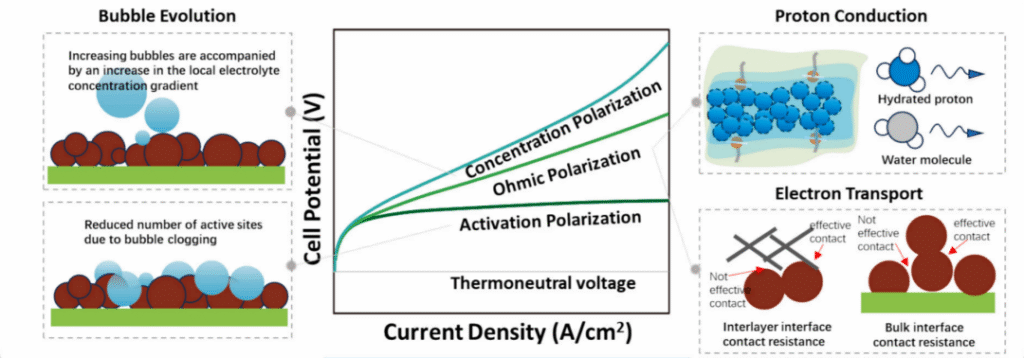
Figure 1. Activation polarization, ohmic polarization, and concentration polarization of the membrane electrode (Applied Energy 401 (2025) 126808)
Ohmic polarization comes from both electronic conduction resistance and proton conduction resistance. It's important to note that here, electronic conduction doesn't refer to the electron transfer that happens at the active sites during electrochemical reactions. Instead, it’s about the flow of electrons passing through the catalyst layer, porous transport layer (PTL), bipolar plates, and wires (including the connections between different components of the stack). So, electronic conduction resistance is related to the assembly clamping force and material properties. Proton conduction occurs in the catalyst layer's proton exchange membrane and ionomer films, and it depends on the water content of the proton exchange membrane, the chemical structure of the ionomer, and the agglomeration morphology.
(1) Proton conduction
Proton exchange membranes and ionomers both serve as solid electrolytes for MEAs. The proton exchange membrane conducts protons and blocks gases, while the ionomer conducts protons and binds to the catalyst. Although differences in thickness and processing between proton exchange membranes and ionomers lead to very different final proton transport pathways (J Power Sources 2022;536:231523), the fundamental mechanism of proton transport is the same. Perfluorosulfonic acid (PFSA) is a commonly used commercial material for proton exchange membranes and ionomers in water electrolysis for hydrogen production, and its ability to conduct protons is closely related to its structural characteristics and water content. PFSA consists of hydrophobic -CF2-CF2- The main chain and hydrophilic sulfonic acid end-group side chains are the components; the main chain mainly controls mechanical strength and thermal properties, while the side chain length is directly related to the ion exchange capacity (EW) of the resin. The shorter the side chain, the smaller the EW, and the stronger the proton conduction performance. In addition, sulfonic acid groups have strong electrophilicity and water absorption, playing an important role in forming continuous hydrated ion channels and facilitating proton migration (SO3H + H2O→SO-3 + H+ + H2O). Chemours' Nafion series is the most representative long-side-chain PFSA membrane. Reducing the membrane thickness from several hundred microns to tens or even below ten microns can significantly decrease the proton conduction resistance of the membrane. Solvay Solexis' short-side-chain Aquivion™ series has attracted attention because it has a lower EW and higher proton conductivity than Nafion membranes, and at the same EW, it can achieve higher crystallinity and a higher glass transition temperature compared to long-side-chain membranes.
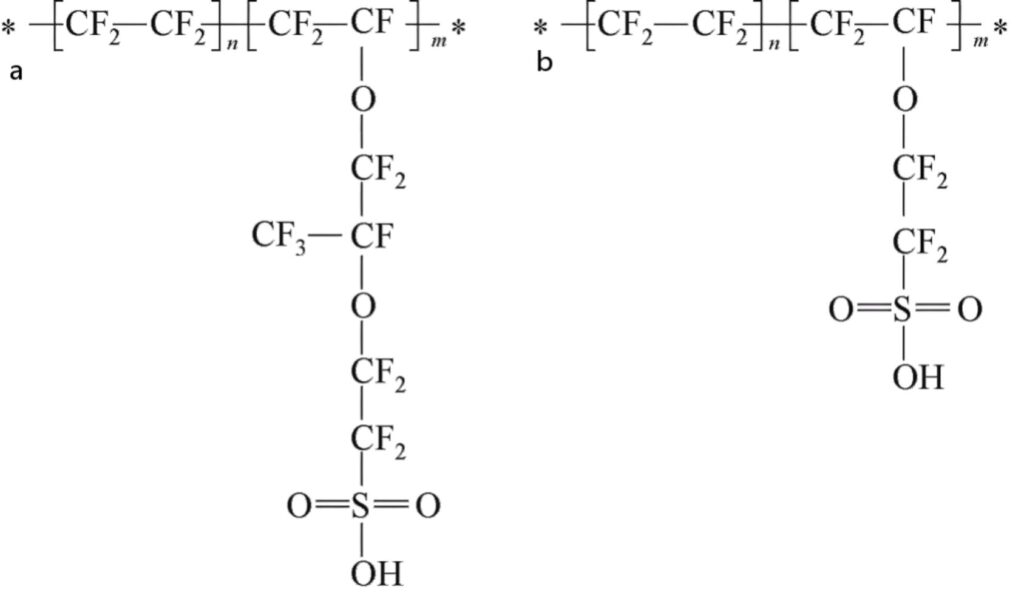
Figure 2. (a) Long-side-chain Nafion series ionomers (b) End-side-chain Aquivion™ ionomers
(2) Electronic Conduction
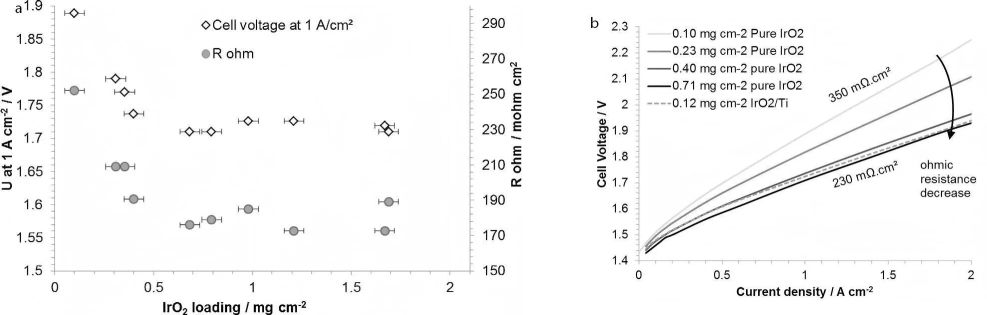
The content and distribution of aggregates have a big impact on electronic conduction in the bulk phase, and the competitive relationship between electronic and proton conduction means that a balance between the two is needed. Mandal and others reported (ACS Appl Mater Interfaces 2020;12:49549-62) in IrOx (1 mg in the catalytic layerIr cm-2), the biggest contributors to ohmic resistance are the relative amounts of catalyst and ionomer. When the ionomer content is below 15%, it causes proton conduction resistance; otherwise, it causes electron conduction resistance. It’s worth noting that the above study was conducted with an Ir loading of 1 mg cm-2As the process continues, with the load decreasing, the contact inside the catalyst layer and between the catalyst layer and the porous transport layer further reduces, which will lead to greater electronic conduction resistance (Figure 3). Research by Rozain and others shows that IrO2The impact of load on performance exists at 0.5 mg/cm-2Below the threshold, high-frequency resistance (HRF) increases sharply and electrolysis performance drops quickly, so conductive supports need to be added to maintain good conductivity and electrochemical activity within the catalyst layer (Applied Catalysis B: Environmental 182 (2016) 153-160).
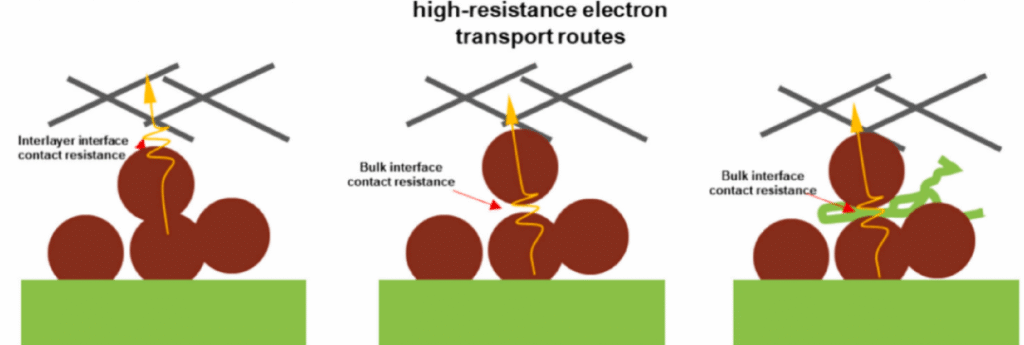
Figure 3. Electron transfer resistance inside the catalyst layer and between the catalyst layer and the porous transport layer (Applied Energy 401 (2025) 126808)
(3) Strategies to Reduce Ohmic Resistance
Change the PFSA monomer structure, use a proton exchange membrane with low EW; pre-treat the PFSA with biaxial stretching to optimize the hydrophilic channels; balance the amount of catalyst and ionomer, and design an integrated electrode structure to improve interface contact.